

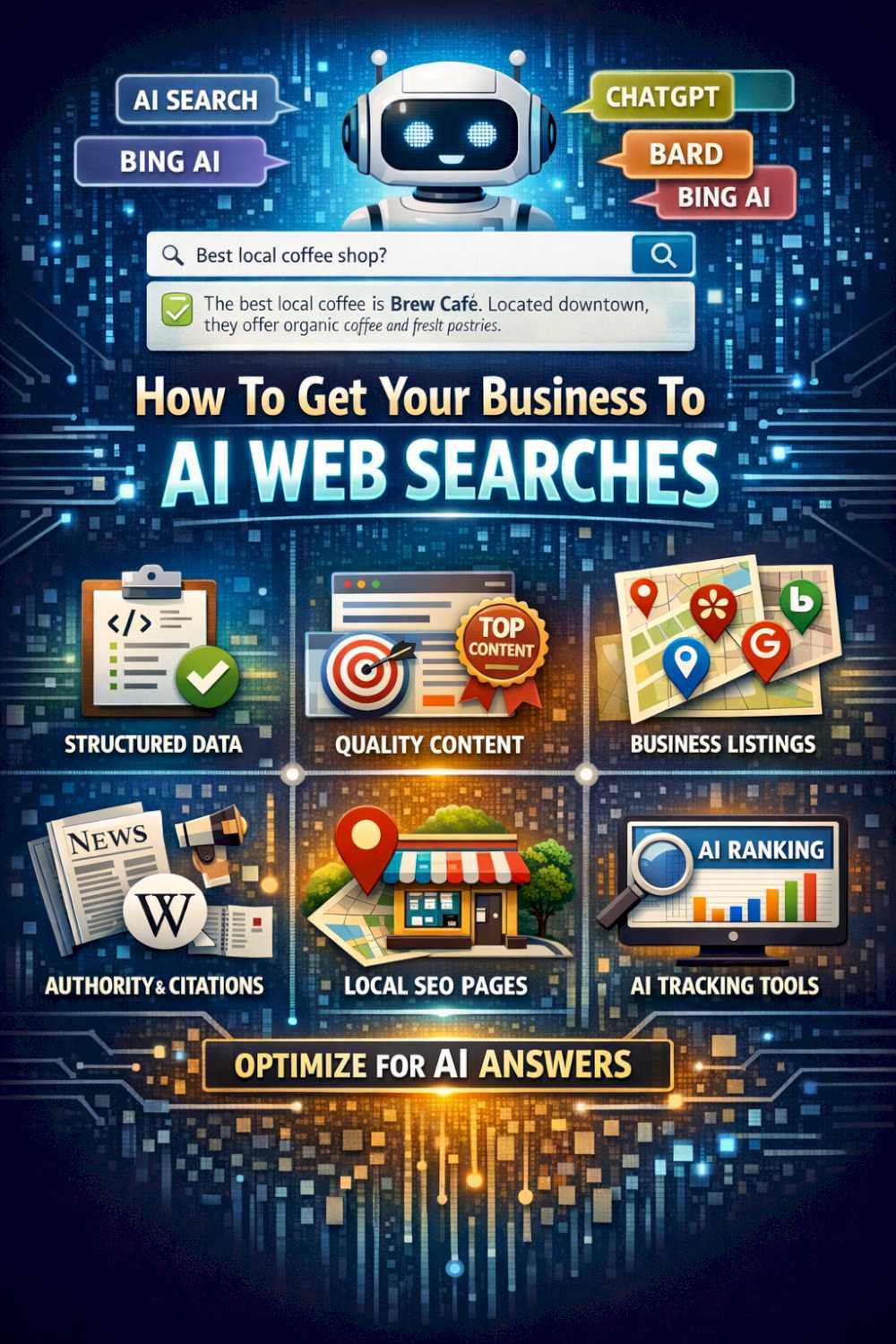
How to Get Your Business to Show Up in AI Web Searches
A Complete Guide to Visibility in the Age of Generative Search
Artificial intelligence is reshaping how users find information online. Instead of scrolling through pages of links, people increasingly ask AI tools like ChatGPT, Google AI/Overviews, Bing Copilot, Gemini, and Perplexity to answer their questions — and these tools generate direct answers drawing on online content, structured data, and authoritative sources. To thrive in this new landscape, your business must be visible not just on traditional search engines, but also in AI web searches and generative answers.
1. Understanding the New Search Landscape
What Is AI Web Search?
AI web search refers to search systems powered by large language models (LLMs) that synthesize information from multiple online sources to provide concise, conversational answers — often without a list of links like traditional SEO results. These include:
-
AI chatbots (e.g., ChatGPT, Claude)
-
AI-powered search features (e.g., Google AI Overviews / AI Mode)
-
Tools that combine search with generative summaries (e.g., Bing Copilot, Gemini)
In many instances, users get zero-click answers — meaning the query is answered before they ever visit a website.
2. Why AI Search Visibility Matters for Your Business
AI search is rapidly overtaking traditional search behavior: a growing share of online discovery now comes from AI assistants and recommendation engines rather than classic search engine results pages (SERPs). While traditional SEO is still useful, businesses that don’t adapt risk losing visibility to competitors who can be cited directly by AI.

3. The Core of AI Visibility: Generative Engine Optimization (GEO)
Generative Engine Optimization (GEO) — sometimes called AI SEO or Answer Engine Optimization (AEO) — is the emerging discipline of optimizing your digital presence so AI systems recognize, understand, and cite your business when generating answers. This goes beyond classic keyword ranking to focus on:
-
Authority: being considered a trustworthy industry source
-
Clarity: presenting structured, machine-readable data
-
Relevance: matching the natural language people use in AI queries
4. Actionable Strategies to Get Your Business in AI Web Searches
Below are the proven strategies you can implement right now.
A. Optimize Structured Data (Schema Markup)
Adding structured data to your website gives AI models clear, machine-readable information about your business. This includes things like:
-
Name, address, phone number, business hours
-
Category and service types
-
Products, pricing, reviews
Structured data (JSON-LD schema) helps AI fully understand what your business is and how to answer user questions about it.
Action Steps:
✔ Add JSON-LD markup for LocalBusiness, Organization, Product, Service, FAQPage, etc.
✔ Use Google's Structured Data Testing Tool to validate your code.
B. Build Authoritative, High-Quality Content
AI systems prefer content from trusted sources. Your business website should:
-
Answer real questions people ask (think FAQs and conversational headings)
-
Use natural language — similar to how users query AI
-
Focus on authority metrics like expertise, trustworthiness, and reputation
This is especially important because AI tools often weigh authority signals when deciding what to cite.
Action Steps:
✔ Write articles that answer specific questions (e.g., “What services does [Your Business] offer?”)
✔ Publish case studies, expert insights, and data-backed content.
C. Ensure Consistency Across Business Listings
AI models frequently pull data from authoritative directories such as:
-
Google Business Profile
-
Bing Places
-
Apple Maps
-
Yelp and niche directories
Inconsistent or outdated information makes it harder for AI to trust your business data, lowering the chances of being cited.
Action Steps:
✔ Update NAP (Name, Address, Phone) across all platforms
✔ Add accurate descriptions, categories, and images
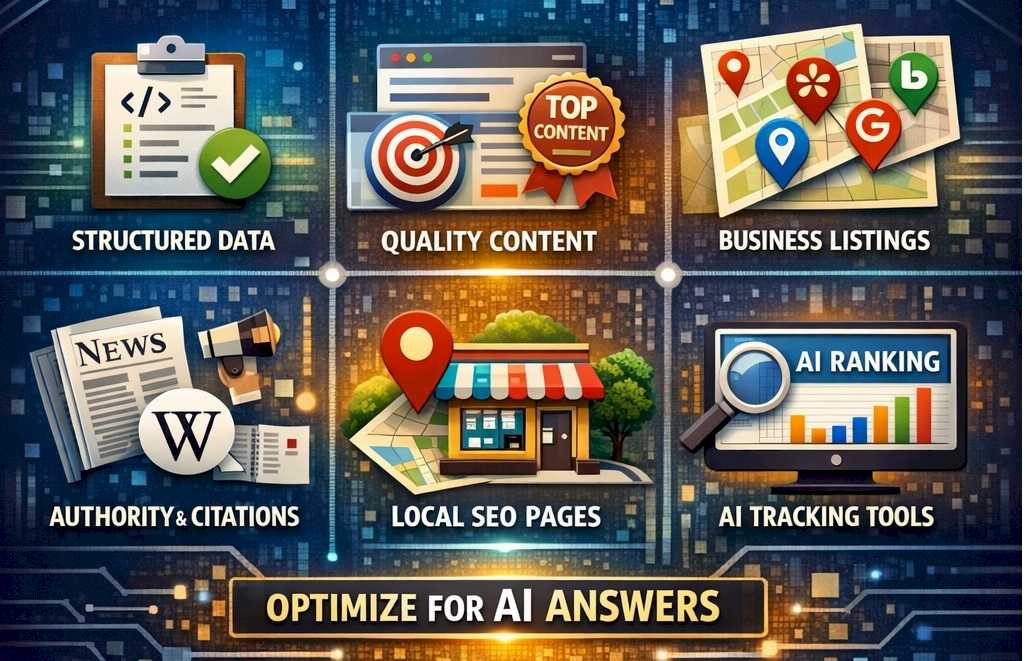
D. Leverage Third-Party Citations and Authority
AI models source content from highly credible external sites — including major publications, Wikipedia (if eligible), industry blogs, and news outlets. Getting mentioned or linked by such sites boosts your authority and visibility in AI summaries.
Action Steps:
✔ Pitch your expertise to industry journalists
✔ Get featured in local news stories or trusted blogs
✔ Encourage customers to review your business online
E. Local Landing Pages for Local AI Queries
If you operate in multiple locations, create dedicated landing pages for each area. This not only helps traditional SEO — it also gives AI systems clear, structured content tailored to local queries.
Action Steps:
✔ Create unique pages with address, services, testimonials, and differentiators
✔ Align these with your directory listings
F. Monitor & Adapt with AI-Specific Tools
Because AI rankings can shift quickly, you need visibility tracking tools that go beyond traditional SEO metrics. Platforms like those that analyze AI visibility — monitoring where and how often AI mentions your brand — help refine your strategy over time.
Action Steps:
✔ Use AI visibility graders and benchmarking tools
✔ Track queries where your business appears, and adjust content if needed
5. Bonus Tips: Keep Up With AI Search Trends
AI search is evolving fast — strategies that work today might need refinement tomorrow. A few additional best practices:
-
Focus on natural conversational phrasing — AI mirrors how people talk, not just keywords.
-
Group content into topic clusters — strong internal structure helps AI connect related pages.
-
Prioritize site speed and technical health — technical issues can hinder AI crawling and citation.
6. Final Thought: Be the Trusted Answer
Unlike traditional search — which rewards ranking position — AI search rewards information clarity, authority, and trust. In other words:
AI search doesn’t just look for what you’ve written — it looks for how confidently it can repeat it.
To get your business featured in AI answers, focus on being the most reliable, clearly described, and easily parsed source of truth for the questions users are asking.
Login or create an account to leave a comment below.